
A sermon by the Rev. Dr. Thee Smith
The Fifth Sunday after Pentecost: Proper 10, Year C
In the name of God:
“Our Maker, Defender, Redeemer, and Friend.” Amen
—The Hymnal, no. 388, “O Worship the King,” v.5
Today, on this Good Samaritan Sunday, we’re being reminded of Jesus calling us to be neighbors to one another. He tells us to do that in the verse that ends our gospel reading today. “Which of these three,” he asked the lawyer in the story: ‘Which of these three, do you think, was a neighbor to the man who fell into the hands of the robbers?’ Of course the lawyer answered correctly: not the priest, nor the Levite, but “‘the one who showed him mercy.’ Jesus said to him, ‘Go and do likewise.’” (John 14:36-37)
But even before today’s Good Samaritan Sunday, we heard this call to be neighbors to one another. It began last Sunday—the Sunday that converged with our Independence Day celebration on the 4th of July. Listen again to our Collect for that day—our collective prayer that is appointed every year on the Sunday associated with the 4th of July.
Collect for the Sunday closest to Independence Day
O God, you have taught us to keep all your commandments by loving you and our neighbor:
Grant us the grace of your Holy Spirit, that we may be devoted to you with our whole heart, and united to one another with pure affection…
—Book of Common Prayer (1979; Proper 9), p. 230-231
Now isn’t that an awesome prayer request, that we may be “united to one another with pure affection?” It’s not enough, what Jesus says elsewhere in holy scripture. When he was asked which is the greatest commandment, he replied:
‘You shall love the Lord your God with all your heart, with all your soul, and with all your mind.’ This is the first and great commandment.
And the second is like it: ‘You shall love your neighbor as yourself.’ On these two commandments hang all the Law and the Prophets.” (Matthew 22:37-40)
No-no; that’s not enough according to today’s prayer book Collect. Rather, every year we get to raise the bar even higher by asking God that we may be “united to one another with pure affection.” It’s a lovely expression, isn’t it? But it’s daunting also: ‘Grant us the grace . . . to be united to one another with pure affection.’
Well, I have a timely example for us to explore today. In anticipation of our closing hymn that we’ll sing later, “a pure and spotless new creation let us be” (Love Divine, All Love’s Excelling, vs. 3), here’s a timely example of finding ourselves here at St. Philip’s “united to one another with pure affection.” A couple of Sundays ago there was something said about my hair. It happened during the two larger services in the Cathedral nave. For those of you who were not here, I’m sharing something that became a subject of lighthearted comments among our congregation.
It was when our beloved vicar, that’s George Maxwell, announced the annual observance here at the Cathedral on the 4th of July. As many of you know, that’s the Blessing of the Runners that we provide as they pass in front of the church during the Peachtree Road Race. In the church announcements George gave a pep talk encouraging people to come to church early before the start of the race. He wanted to motivate some of us to join our clergy as we gather to bless the participants; and to applaud and shout encouragement to them as the participants, runners and walkers alike, come down Peachtree Road.
‘This year,’ George announced, ‘this year Thee Smith will deliver the invocation at the start of the race up the road at Lenox Mall.’ Then he explained further: “But immediately after giving the invocation, Thee will need to get back to the church in good time—in time to join the other clergy as they begin sprinkling holy water from their blessing bowls onto the first runners coming down the road.’
And then George offered everyone this incentive. ‘If you arrive early enough before the race starts you can get to see Thee being carried down the road on the back of a motorcycle with his hair waving in the wind!’
That’s right, he said with an impish smile on his face. ‘Come see Thee on the back of a motorcycle with his locs waving in the wind!’ That’s the image George implanted in everyone’s mind. That’s the way he ‘hammed it up.’ In good humor everyone laughed of course; and me too of course. Like everyone else in church that day, I found it a hilarious image. And even though I was not transported from Lenox Mall back to the Cathedral on the back of a motorcycle that day, but in an official special events escort car, I doubt that I will ever be able to get that imaginary picture out of my mind for the rest of my life. Thanks a lot, brother George!
But here’s really why I’m recounting that story for us here today. For the rest of that service—for those minutes and days following that moment of hilarity, we were ‘united to one another with some kind of pure affection.’ The impact of that moment was infectious and instructive, because in that laughter we were no longer strangers but friends and neighbors.
For sure, people were connecting in a friendly way to me as an African American man with my hair in locs. But people were not only connecting to me. Rather we were connecting to one another as a kind of beloved community—as a community where there is sufficient trust and familiarity that we are in relationship with one another; so that we can enjoy camaraderie as comrades.
Precisely here, therefore, let me pose a question that connects all that wit and hilarity to our gospel themes for today. On this Good Samaritan Sunday, here’s a pertinent question. Church family and friends of Christ, I ask you a real, honest question that is not a rhetorical question. It’s not a question for which I have a predetermined answer. It’s a question, rather, that I struggle with as much as any of us.
On this Good Samaritan Sunday, in the Year of Our Lord 2025, are we a ‘nation of strangers,’ or do the Good Samaritans among us determine our national character? That’s the question, church family and friends of Christ. And I repeat it for clarity:
Are we a ‘nation of strangers,’ or do the Good Samaritans among us determine our national character?
I ask that question with the same reverse logic that Jesus exercised when he turned that lawyer’s question back on the lawyer himself; back on the questioner himself who asked, ‘And who is my neighbor?’ The reverse of that question, as Jesus himself turns the question around, is this: ‘Rather, who are you as a neighbor?’ or ‘How are you being a neighbor?’
According to the parable, neighbors are people who bind up the wounds of each other when we fall by the wayside; and neighbors are people who provide resources for each other in need. Rather than passing each other by like the uncaring clergy in the parable, neighbors stop and intervene in each other’s distressing moments so that worse things do not happen by neglect or indifference.
But here is where I struggle on this Good Samaritan Sunday. It has to do with our first scripture reading appointed for today. My struggle has to do with the way that first reading raises a challenge for Jesus’ parable of the Good Samaritan. My struggle has to do with the same challenge that Moses gave to ancient Israel in today’s first reading. “Surely, this commandment that I am commanding you today is not too hard for you,” Moses declared.
Nor is it too far away. It is not in heaven, that you should say, ‘Who will go up to heaven for us, and get it for us so that we may hear it and observe it?’
. . . No, the word is very near to you; it is in your mouth and in your heart for you to observe. (Deut. 30:11-14).
When I apply Moses’ words to our country as a nation of fellow citizens, I really want it to be true that being neighbors to one another is ‘not too hard for us,’ and ‘not too far away,’ but rather ‘very near to us,’ and accessible ‘in our mouths and in our hearts for us to observe.’ But I’m haunted by increasing evidence of the kind of society that Ayn Rand depicted in her 1957 novel, Atlas Shrugged.
Atlas, you may recall from Greek mythology, was one of the Titans who lost their battle with Zeus and the other Olympian gods. As punishment, Atlas was condemned to hold up the heavens or sky on his shoulders for all eternity. He is typically featured with the globe of the world bowing him down under its weight. So it is a fitting image that Ayn Rand gave us in her title theme, where she invited readers to imagine Atlas somehow shrugging off his burden and freeing himself from its tyranny.
Atlas Shrugged advocates just such a society where productive individuals refuse to continue supporting government programs that they believe exploit their talents and efforts on behalf of less productive people; people whom they regard as undeserving or “looters.” Here we have a counter-narrative to the stories and parables that scripture offers us today and every day.
In Ayn Rand’s alternative narrative, we are living in the time of Atlas shrugged: a time when many of our fellow citizen experience our Judeo-Christian values as increasingly burdensome, as too hard to bear, as exploiting their productivity and well-earned wealth. So here I ask you: Are more and more of us feeling overwhelmed by ideals that exhort us to be Good Samaritans for one another; overwhelmed because those ideals feel like too much to bear—too idealist and unrealistic; so unjust and tyrannical that people are pushing back and ‘going on strike’ against all that idealism and altruism on behalf of others whom they regard as strangers and not as neighbors or fellow citizens?
Are we therefore becoming a nation of strangers rather a nation where being Good Samaritans is the norm; so normative that it defines our national character? I believe that we can best address that question by doing what Jesus does in today’s parable: reversing the question radically. The question, therefore, and once again, is not ‘Who is my neighbor?’ but rather, ‘Who am I as a neighbor,’ and, ‘How am I being a neighbor?’
But just here, as people of faith, we may be doing an injustice to others by asking them to attempt to be neighbors in their own strength; that is, without some kind of allegiance to something greater than themselves—whether something religious or something humanist. What is true for us, as well, is something that we also need to acknowledge is true for our fellow citizens.
Only by acting in allegiance to something greater than ourselves have we believers been able joyfully to sustain being a neighbor to others as something bearable, even rewarding; as something other than an unbearable burden; as something other than the kind of burden under which many of our fellow citizens shrug when they feel like Atlas: that is, condemned to bear an eternal punishment.
So that is why we pray for divine grace here in church every Sunday. (Note our Colossian’s reading appointed for today: ‘Just as the Gospel is bearing fruit and growing in the whole world, so it has been bearing fruit among yourselves from the day you hear it and truly comprehended the grace of God;’ vs. 1:6.) Indeed, it is the grace that we prayed for at the beginning of our service today, in our Collect appointed for this Sunday after Independence Day:
Collect for Good Samaritan Sunday
O Lord, mercifully receive the prayers of your people who call upon you, and grant that they may know and understand what things they ought to do, and also may have grace and power faithfully to accomplish them…
—Book of Common Prayer (1979; Proper 10), p. 231
So yes, as neighbors we pray that our fellow citizens may share in the same grace that we pray to receive ourselves. It is the grace that we too stand in need of in order not to become a nation of strangers. It is the “grace and power faithfully to accomplish” the kind of world that Jesus calls us to be citizens of in today’s parable.
So come, Holy Spirit (with hands raised in prayer and supplication), and “mercifully receive the prayers of your people who call upon you, and grant that they may know and understand what things they ought to do, and also may have grace and power faithfully to accomplish them.” Amen.
____________________
APPENDIX
A. Selected “Nation of Strangers” Tropes
Influential Books
A Nation of Strangers
Vance Packard | NY: David McKay Co., 1972
Vance Packard, one of our most incisive social commentators, in this book deals with an urgent problem: the mass uprooting and the fragmentation of our society, which is turning into a "nation of strangers". We are living in a continually changing environment, fast relinquishing a basic human need: a sense of community. Forty million Americans now lead feebly rooted lives. At least a fifth of all Americans move one or more times a year, and the pace is increasing. What new institutions is this rootlessness creating.? What is its impact on our values, our behavior, our emotional well-being? —Amazon.com
______________
A Nation of Strangers: Prejudice, Politics, and the Populating of America
Ellis Close | NY: William Morrow & Co., 1992.
Analyzes the complicated political and social forces that have shaped U.S. immigration policies and examines how the American melting pot philosophy coexists with tendencies toward xenophobia, prejudice, and paranoia. —Amazon.com
Related News Articles
Keir Starmer’s “island of strangers”
What was the Prime Minister really saying about immigrants and immigration?
David Miller | The New Statesman | 17 May 2025 https://www.newstatesman.com/ideas/2025/05/keir-starmers-island-of-strangers
Excerpts:
In 2016, when he was a Shadow Home Office Minister, I posted Keir Starmer a copy of my book about immigration, Strangers in Our Midst. Starmer has made it very clear that he’s not a great reader – of fiction anyway – and I didn’t receive an acknowledgement, so I claim neither credit nor discredit for his claim that uncontrolled immigration risks turning Britain into an “island of strangers”. The phrase has become the locus for a vitriolic exchange of views in recent days, read not as an echo of a work of academic philosophy, but of Enoch Powell’s “Rivers of Blood” [1968] speech, in which Powell championed those who “found themselves made strangers in their own country”.
Starmer’s meaning was clearly different from Powell’s. And it would be a shame if that deflected attention away from the main purpose of his speech . . .
. . . . . . . . . . . . . . . . .
There is, however, a deeper link between social justice and immigration policy, and this may have been what Starmer was pointing to with his controversial “strangers” remark. It’s long been known that the societies that have gone furthest in pursuit of social democratic policies – the Scandinavian democracies especially – have also been societies that enjoy a high level of social trust. Trust between citizens is what encourages them to support policies from which they may not benefit directly, not only in the area of social justice but on long-term issues, such as combatting climate change. Trusting others means relying on them not to cheat the system that’s been put in place (for example when claiming welfare benefits) and also counting on them to support you should circumstances change and you are the one who needs help.
But the question then is how trust is created between people who may indeed at first be strangers to one another. Social psychologists working on this issue tell us, perhaps not surprisingly, that two of the strongest predictors of interpersonal trust are direct social contact and cultural similarity. In experiments where a group of people can increase the resources they hold by investing them in a collective pot which is then divided equally (so self-interest recommends not investing but still claiming a share of the pot), allowing the participants to talk to one another for a while before deciding substantially increases the level of investment. Other experiments use the same device to test for the effect of cultural similarity. People who are told that they share cultural features with other members of the group – even seemingly irrelevant features such as sharing tastes in art – are more likely to invest. And when you invest you are trusting your fellows to do the same, so that everyone benefits and no one free rides . . .
___________
Starmer’s ‘island of strangers’ speech didn’t go far enough
Rakib Ehsan, The Telegraph | Fri, June 27, 2025 at 7:37 AM EDT https://www.telegraph.co.uk/news/2025/06/27/starmers-island-of-strangers-speech-regret/
Excerpt:
The Prime Minister also had the opportunity to flesh out a more communitarian agenda for the country at large. Over time, we have become a more atomised and individualistic society – one defined by family fragility, declining community spirit, and a lack of solidarity between the generations. Rapid secularisation means that many churches are no longer at the heart of communal life in many communities across Britain. The harsh winds of globalisation ripped industry out of many traditional working-class areas, and this has damaged local civic pride.
The only regret the Prime Minister should have on this front is failing to provide his much-needed “island of strangers” speech with the intellectual weight it deserved . . . [and] caving in to the so-called “progressive” attacks on it . . .
B. Selected “Atlas Shrugged” Memes, Images, Blogs
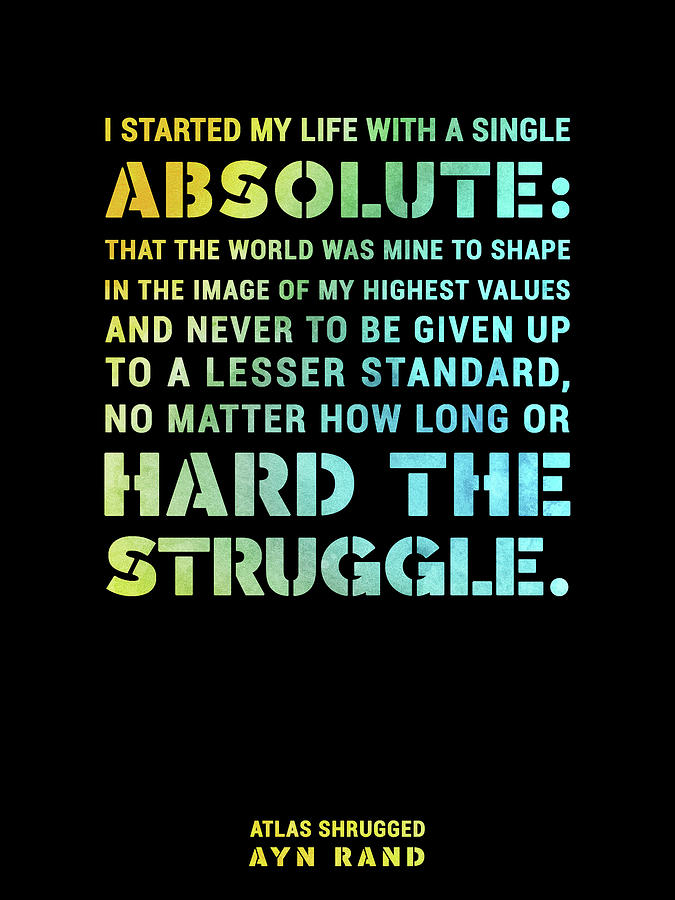
“I started my life with a single absolute: that the world was mine to shape in the image of my highest values and never to be given up to a lesser standard, no matter how long or hard the struggle.”
Atlas Shrugged Quotes | images.fineartsamerica.com accessed July 5, 2025 https://images.fineartamerica.com/images/artworkimages/mediumlarge/3/i-started-my-life-with-a-single-absolute-ayn-rand-atlas-shrugged-quote-01-typographic-print-studio-grafiikka.jpg m

_______________

Atlas Shrugged | Penguin 2005 jacket cover accessed July 5, 2025 https://books.google.com/books/about/Atlas_Shrugged.html?id=bVyCd7da8OcC; Detail: Atlas Shrugged | ‘Burden’ | H.M. Turnbull, “Why Ayn Rand’s ‘Atlas Shrugged Is the Worst Novel I've Ever Read” | accessed July 5, 2025 https://hmturnbull.com/?s=atlas+shrugged
_____________________________________________

Atlas Shrugged | Amazon.com Generic Brand first available July 4, 2024 | accessed July 5, 2025| https://www.amazon.com/Shrugged-PosterWall-Aesthetic-24x36inch-Unframe-style/dp/B0D8VK75Y2